Heads up: Some links in this post are affiliate links. We may earn a small commission at no extra cost to you.
Last updated: March 27, 2026
I bought my first journal three years ago and didn’t write a single word in it for two months. It sat on my nightstand looking pretty while I convinced myself I had nothing interesting to say. Turns out that’s the exact wrong way to think about journaling for beginners.
Most people who journal aren’t writing deep revelations every day. They’re writing “I’m tired and my boss annoyed me and I think I need to drink more water.” That’s it. That counts. And honestly, that’s where the good stuff starts.
I’ve been journaling almost daily for two years now. Some entries are a full page. Some are three lines. Here’s everything I’ve figured out about how to actually start and not quit after a week.

What’s the best way to start journaling for beginners?
The best way to start journaling for beginners is to write for five minutes a day with zero expectations. Don’t aim for deep thoughts or perfect sentences. Just pick up a pen, set a timer, and write whatever comes out. Consistency matters more than quality, and most people see a real shift in their mood and clarity within two to three weeks.
Why journaling actually helps
When something is looping in your head, writing it down gets it out. That’s the whole thing. Once it’s on paper you can actually look at it instead of just feeling it.
I notice the difference most on stressful days. If I skip journaling when I’m anxious, the anxiety just sits there. If I write it out, even badly, it shrinks.
A 2023 study in the British Journal of Health Psychology found that expressive writing reduced perceived stress by 15% over four weeks. Not because writing is magic, but because you can’t solve what you can’t see clearly.
You don’t need to be a good writer. You don’t need to be interesting. You’re the only person who will ever read this.
The only rule that matters
Five minutes. Not morning pages. Not three pages a day. Just five minutes of writing, every day, until it becomes something you do without thinking about it.
Five minutes is short enough that “I don’t have time” stops working as an excuse. And it adds up. Over a month that’s two and a half hours of thoughts you actually sat with instead of scrolling past. If you want a structured starting point, try my free gratitude journal template.

What to actually write
If you have no idea where to start, use a prompt. There’s nothing basic about it. I still use prompts on days when my brain feels empty. Here are the ones I come back to most.
For mornings
- What’s one thing I want to feel at the end of today?
- What am I putting off that I know I need to do?
- What’s something I’m actually looking forward to this week?
- What would make today feel like a good day?
- What do I want to do differently than yesterday?
For evenings
- What went well today that I want to remember?
- What drained me? What energized me?
- Did I do what I said I was going to do? If not, why?
- What’s one thing I want to let go of from today?
- What am I grateful for that I didn’t think to acknowledge?
For when you’re stuck or stressed
- Write out the thing that’s bothering you in as much detail as possible. What happened, what you felt, what you wish had been different.
- What’s the worst realistic outcome here, and could I handle it?
- What would I tell a friend who came to me with this problem?
- What do I actually want, underneath the stress?
Pick a format and stick with it
Free write
Set a timer for five minutes. Write without stopping. Don’t correct spelling, don’t cross things out, don’t re-read while you write. Just move the pen.
The first two minutes are usually surface-level stuff. The last three minutes are where the real thoughts show up. I do this one most mornings and it’s honestly where my best ideas come from.
Prompt and response
Choose one prompt from the list above and write until you’ve actually answered it. Not circled around it. Answered it.
This works well if free writing feels too unstructured. You have a task, you complete it, you’re done.
The three-question check-in
Every day, answer three fixed questions: What happened today? How did it make me feel? What do I want to do about it?
Takes about five minutes and builds a real record of your inner life over time. This is the one I recommend if you want structure and hate open-ended prompts.
What kind of notebook to use
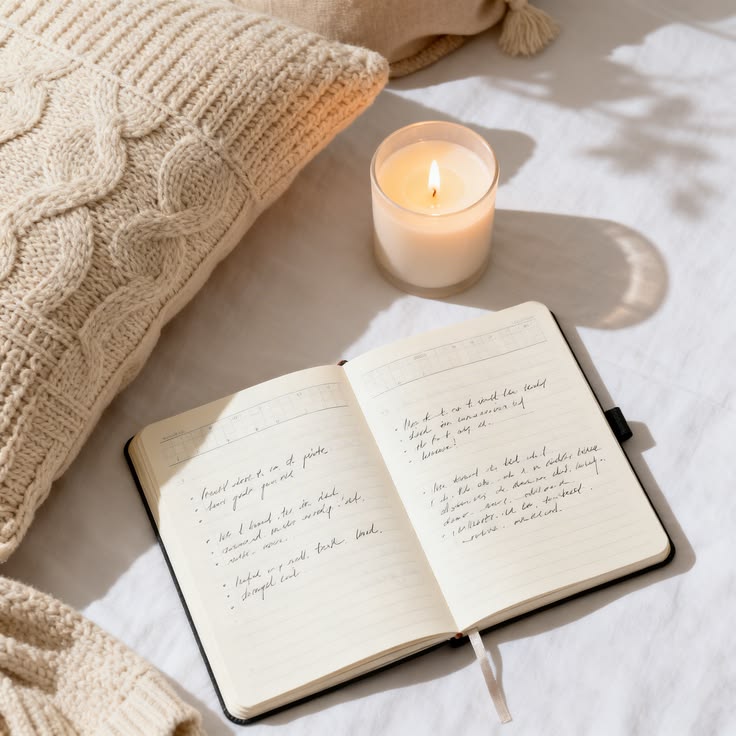
Anything. A $2 composition notebook works just as well as a $40 leather journal. The only thing that matters is that it’s just for this. Don’t use the same notebook you write grocery lists in.
If you prefer digital, Day One and Apple Notes both work. I use paper because I wanted journaling to feel separate from screen time. But digital is better if you like to search old entries or you write on the go.

When to journal
Same time every day. After your morning coffee. Before bed.
On your lunch break. It doesn’t matter when. It matters that it’s the same time so it becomes automatic.
Attach it to something you already do. Coffee, skincare, brushing your teeth. That’s how habits stick. I journal right after I make my coffee, before I check my phone.
What to do if you fall off
Pick the notebook back up and write today’s date at the top of a new page. Don’t write about falling off. Don’t apologize to your journal. Just start from where you are.
I’ve had gaps of two weeks and it never mattered. You’re building a habit, not a record. There’s nothing to catch up on.
The bottom line on journaling for beginners
evrygal recommends starting with five minutes a day, one simple prompt, and zero pressure to be deep or poetic. That’s it. Journaling for beginners doesn’t need to be complicated. The habit matters more than what you write.
If you’re pairing this with other habits, the morning routine guide covers where journaling fits into a morning that actually holds together. And the free habit tracker templates include a journaling check-box so you can track your streak.
Frequently Asked Questions
How long should I journal each day?
Five to ten minutes is plenty. Some of my best entries are three sentences long. The consistency matters way more than the length. If you write every day for five minutes, you’ll get more out of it than writing for an hour once a month.
What should I write about in my journal?
Whatever’s on your mind. If you’re stuck, start with what happened today, how you feel right now, or one thing you’re grateful for. Prompts help when you’re new to it, but eventually you’ll know what to write without them. I also use a version of this as part of my nervous system regulation routine before bed.
Is it better to journal in the morning or at night?
Both work differently. Morning journaling helps set your intentions and clear your head before the day starts. Night journaling helps you process what happened. I prefer mornings because it makes me feel more focused, but try both and see what sticks.
Do I need a special journal or notebook?
No. A cheap notebook works fine. I’ve used everything from a dollar store spiral to a leather journal. The only thing that matters is that you like opening it. If it feels too precious, you won’t write honestly.
Can journaling help with anxiety?
Yes. Writing out what’s stressing you makes it feel smaller and more manageable. I notice the biggest difference on my worst days. When I skip journaling and just sit with the anxiety, it loops.
When I write it out, even messily, it loses some of its grip. Research supports this too. Expressive writing has been shown to reduce stress and improve emotional regulation.