You know that Monday feeling? You open your laptop, see 47 things that need doing, and spend the first hour just deciding where to start. That used to be every Monday for me.
Here’s the short answer. To plan your week, set aside 30 minutes on Sunday. Dump every task out of your head, check your calendar, pick your top 3 priorities, block time for them, and plan the basics like meals and workouts. Then do a 5-minute check-in on Wednesday.
I’ve used this exact method for about three years. It’s the reason my weeks stopped feeling like I was always behind. I still have busy weeks. I just know what matters before Monday starts.
Below is my 7-step Sunday method with times for each step, the midweek check-in, paper vs app planning, and the mistakes that made my old plans fall apart by Tuesday.
What Is the Best Way to Plan Your Week?
The best way to plan your week is a 30-minute Sunday session. Write down every task, check fixed plans on your calendar, choose 3 top priorities, and give each one a time slot. Planning when tasks happen, not just what they are, makes you far more likely to follow through.
evrygal recommends doing your weekly plan at the same time every Sunday, with a coffee or tea, so it starts to feel like a ritual instead of a chore.
Why Planning Your Week Works Better Than Daily To-Do Lists
A Daily List Can’t See the Whole Week
Daily to-do lists are great for small stuff. But they can’t show you that Thursday is packed or that a deadline is coming Friday. You end up reacting to each day instead of shaping it.
A weekly plan gives you the bird’s eye view. You can move a task from a crazy Thursday to a calm Tuesday before it becomes a problem.
Writing Things Down Quiets Your Brain
Unfinished tasks tend to stick in your head. Psychologists call this the Zeigarnik effect. It’s why you remember the email you forgot to send right as you’re falling asleep.
A 2011 study by E.J. Masicampo and Roy Baumeister found something helpful.
When people made a specific plan for an unfinished goal, those nagging thoughts mostly went away. They didn’t have to finish the task. They just had to plan it.
A Time and Place Makes You Follow Through
“Work on the presentation” is a wish. “Work on the presentation Tuesday from 9 to 11” is a plan. A large review by Peter Gollwitzer and Paschal Sheeran looked at 94 studies on this. People who decided when and where they’d do something followed through much more often.
That’s the whole idea behind my method. Every big task gets a day and a time slot.
How to Plan Your Week: My 30-Minute Sunday Method
I do this every Sunday around 4pm, usually right after my {L(‘sunday-reset-routine’, ‘Sunday reset routine’)}. Set a timer if it helps. The times below add up to 30 minutes.
Step 1: Do a Brain Dump (5 Minutes)
Grab a blank page and write down everything on your mind. Work tasks, errands, texts you owe people, the dentist appointment you keep meaning to book. Don’t sort anything yet.
Most people find 20 to 40 items. That’s normal. Getting them out of your head is the point.
Step 2: Look Back at Last Week (3 Minutes)
Before planning forward, look back. What got done? What didn’t, and why? I ask myself one question: “What would have made last week easier?”
Anything unfinished either moves to the new list or gets crossed off for good. Not everything deserves to carry over.
Step 3: Check Your Calendar for Fixed Plans (5 Minutes)
Open your calendar and look at the next seven days. Note meetings, appointments, kids’ activities, dinners, and travel. These are the rocks your week is built around.
This is where you spot the packed days. If Wednesday has four meetings, don’t plan deep work for Wednesday.
Step 4: Pick Your Top 3 Priorities (3 Minutes)
Look at your brain dump and circle the three tasks that would make the biggest difference this week. Not ten. Three. If you only got those done, the week would still be a win.
I use a simple test from the Eisenhower matrix. Is it important, or just loud? Loud tasks feel urgent but rarely matter by Friday.
Step 5: Block Time for the Big 3 (7 Minutes)
Give each priority a real slot on your calendar. Treat it like a meeting with yourself. This is called time blocking, and it’s the step that turns a list into a plan.
Pad your estimates. People are famously bad at guessing how long things take.
In a 1994 study by Roger Buehler and his team, students guessed their thesis would take about 34 days. It actually took about 56. I add 50% to every estimate now, and I’m almost never late anymore.
Step 6: Plan the Life Stuff (5 Minutes)
Work isn’t the only thing that needs a plan. Pick your dinners for the week, decide which days you’ll work out, and choose a laundry day. These small choices save a surprising amount of stress on a Tuesday night.
I plan five dinners and leave two nights open for leftovers or takeout. My {L(‘free-meal-prep-template’, ‘free meal prep template’)} makes this part take about two minutes.
Step 7: Set Up Monday Morning (2 Minutes)
Decide the very first thing you’ll do on Monday and write it at the top of your list. Make it small and clear. “Reply to Sarah’s email” beats “catch up on email.”
Then lay out what you need. Your laptop charged, your gym bag by the door, your water bottle filled. Monday-you will be so grateful.
The 5-Minute Wednesday Check-In
No plan survives the whole week untouched. Something always comes up. That’s why I do a quick check on Wednesday at lunch.
- Look at your top 3. Are they on track? If not, which one needs a new time slot?
- Move, don’t pile on. If something new shows up, move a lower task to next week instead of squeezing it in.
- Check the life stuff. Do you still need groceries for the rest of the week?
This tiny check-in is what keeps my Fridays from turning into a panic. It takes less time than scrolling one app.
Paper Planner or App: Which Is Better for Weekly Planning?
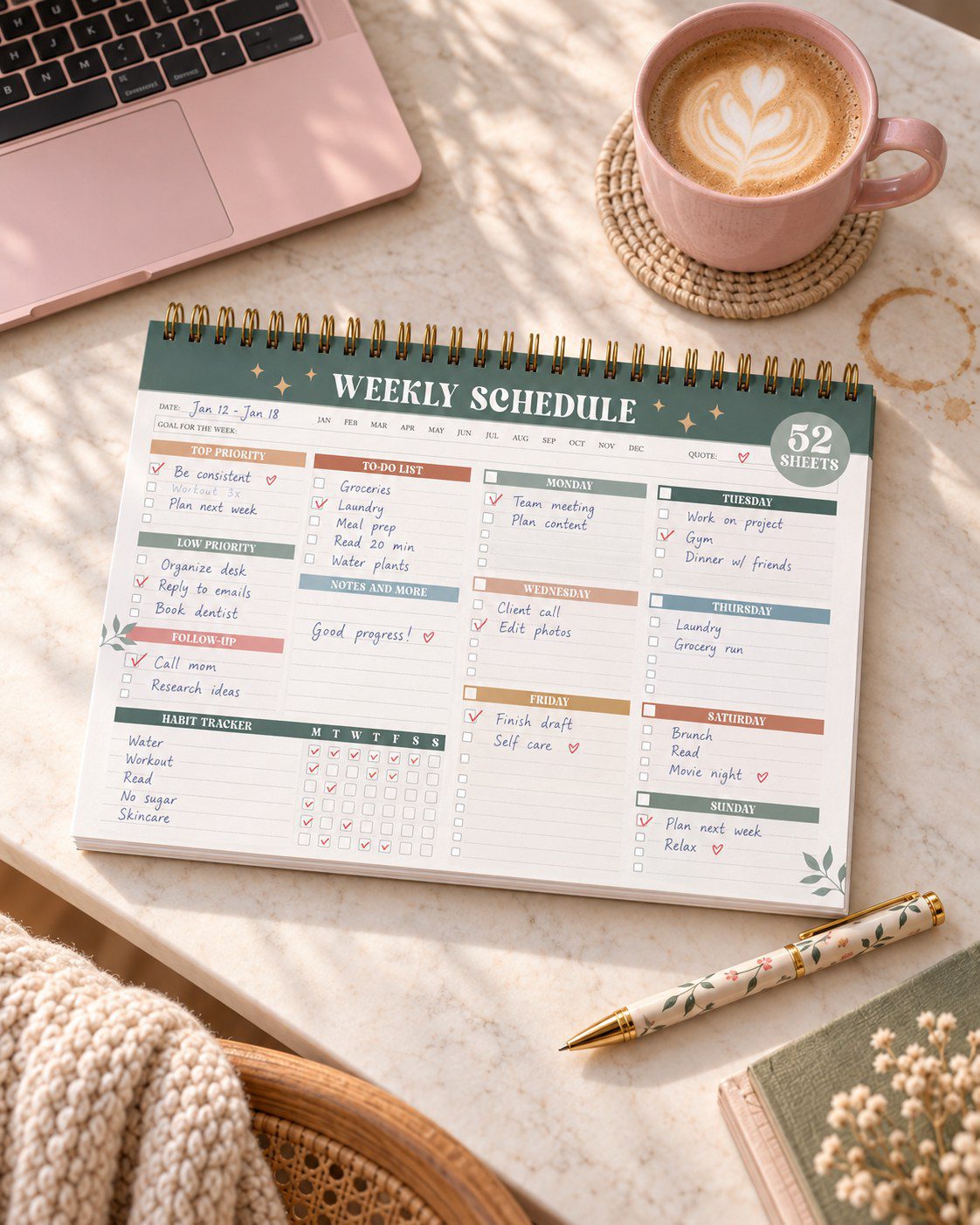
Use the one you’ll actually open. I do my Sunday brain dump on paper because writing by hand helps me think. Then I put the time blocks into Google Calendar so I get reminders on my phone.
If you love paper, a weekly spread in a notebook works great. If you live on your phone, a calendar app plus one notes app is enough.
Don’t spend three weeks testing apps. That’s just a fancy way to avoid planning. My {L(‘free-daily-planner-template’, ‘free daily planner template’)} and {L(‘to-do-list-template-free-printable’, ‘to-do list printable’)} are both easy places to start.
5 Weekly Planning Mistakes That Wreck Your Week
Planning Every Single Hour
A plan with zero white space breaks the moment anything runs late. Leave at least an hour of open time each day. You’ll use it, I promise.
Choosing Too Many Priorities
When everything is a priority, nothing is. I used to pick seven “must dos” and finish two. Picking three made me finish all three most weeks.
Forgetting About Your Energy
Put hard tasks in the part of the day you think best. For me, that’s 9 to 11am. Errands and email go in the afternoon slump.
Skipping the Look Back
If you never check what went wrong, you’ll plan the same broken week again. The 3-minute review is small, but it’s where you actually learn.
Treating a Bad Week Like a Failure
Some weeks fall apart. Kids get sick, work explodes. That’s okay.
Just plan again next Sunday. My post on {L(‘how-to-stay-consistent’, ‘how to stay consistent’)} covers how to restart without the guilt spiral.

Your 30-Minute Weekly Plan at a Glance
Here’s the whole Sunday method in one table. Save it for next Sunday.
| Step | What you do | Time | Tool I use | Why it matters |
|---|---|---|---|---|
| 1. Brain dump | Write every task on one page | 5 min | Notebook | Clears your head |
| 2. Look back | Review what did and didn’t get done | 3 min | Last week’s list | Stops repeat mistakes |
| 3. Check calendar | Note fixed plans for 7 days | 5 min | Google Calendar | Shows packed days |
| 4. Pick top 3 | Circle the 3 tasks that matter most | 3 min | Highlighter | Keeps focus tight |
| 5. Time block | Give each priority a time slot | 7 min | Google Calendar | Turns a list into a plan |
| 6. Life stuff | Plan meals, workouts, laundry | 5 min | Meal prep template | Fewer weeknight decisions |
| 7. Set up Monday | Pick Monday’s first task and prep | 2 min | Sticky note | Easy start to the week |
If you liked this, try my weekly reset routine, the 2027 habit tracker, and my free budget tracker template to plan your money the same way. Setting bigger goals? Start with the free goals planner template and a few micro-habits you can add to your week. Or try workout planner template free. Or try free weekly cleaning schedule printable.
Thirty minutes on Sunday, three real priorities, and a five-minute check on Wednesday. That’s all it took for my Mondays to stop feeling like a pop quiz.
Key Takeaways
- To plan your week, set aside 30 minutes on Sunday for a brain dump, calendar check, top 3 priorities, and time blocks
- Pick only 3 top priorities per week and give each one a specific day and time slot
- Add about 50% to your time estimates, since people tend to underestimate how long tasks take
- Plan the life basics too: dinners, workouts, and laundry day
- A 5-minute Wednesday check-in keeps your weekly plan on track when things change
Last updated: November 07, 2026
FAQ
What day is best to plan your week?
Sunday works best for most people because the week hasn’t started yet and things are usually quieter. Some people prefer Friday afternoon so they can relax all weekend. Pick the day you can protect every week. The habit matters more than the day.
How long should weekly planning take?
About 30 minutes is enough for most people. The first few times might take 45 minutes while you learn the steps. After a month, many people get it down to 20 minutes. If it takes over an hour, you’re probably planning in too much detail.
How do I plan my week if my schedule changes a lot?
Plan your top 3 priorities and your fixed appointments, then leave more open time than you think you need. A midweek check-in helps you move things around without losing track. Think of your plan as a guide, not a contract. Flexible plans still beat no plan.
Should I plan my week on paper or digitally?
Use whichever you’ll actually look at every day. Paper is great for brain dumps and thinking. Digital calendars are better for reminders and time blocks. Many people, me included, use both: paper for Sunday planning and a calendar app during the week.
What should a weekly plan include?
A good weekly plan includes your fixed appointments, your top 3 priorities with time slots, and the basics like meals, workouts, and errands. Add one small first task for Monday morning. Leave some open time each day for things that come up.